
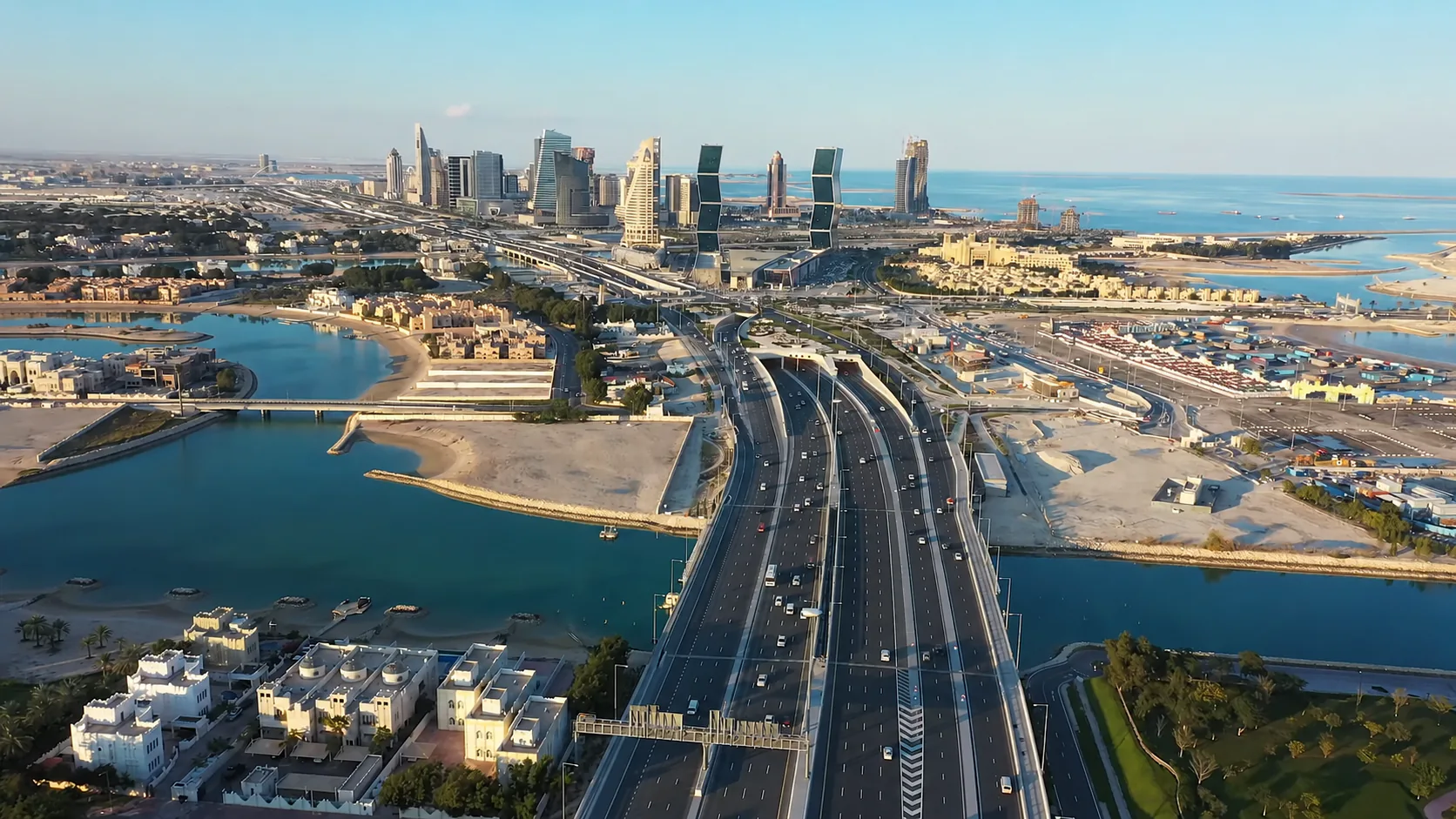
Use the road sign, not a country-wide guess
Qatar's official visitor guidance says urban limits are generally in the 60–100 km/h range and that the highway maximum is 120 km/h. The Ministry of Transport's road hierarchy likewise provides for light-vehicle posted speeds up to 120 km/h on freeways and expressways.
These are network parameters, not permission to select 120 km/h everywhere. Interchanges, tunnels, urban approaches, weather and works can produce lower signed limits, and the current sign always controls.
Assume camera enforcement is active and leave enough following distance to reduce speed smoothly when a lower sign appears.
Phone, cameras and traffic points
Qatar's Ministry of Interior cites Article 55 for a QR 500 fine when a hand-held mobile phone or another device distracts the driver. Official campaigns also state that monitoring systems are used to detect the offence.
Hukoomi describes a points system in which a licence may be suspended after the first accumulation of 14 points. For a visitor, the responsible interpretation is simple: a fine can affect more than the rental invoice and should never be treated as a travel cost.
Match the licence route to the duration of the visit
Qatar's official driving-licence guidance distinguishes several visitor routes: an approved national licence may be used for one week; a temporary licence may be available for up to three months; and a valid International Driving Permit may be used for up to six months, subject to the stated conditions and verification by the Traffic Department.
The same official guidance notes that temporary- and international-licence holders are generally limited to rental vehicles because insurance policies require a full licence for private vehicles. Confirm the precise case before accepting a vehicle.
- Carry the original national licence and the document that supports its use in Qatar.
- Confirm that the rental company and its insurer accept the exact licence and IDP combination.
- Do not lend the vehicle to a driver who is not named and approved on the agreement.
- Recheck the Traffic Department if the stay, immigration status or vehicle type changes.
First-hour setup
Documents
Photograph the agreement, insurance, registration and incident contacts while retaining originals as required.
Vehicle
Record condition, tyres, fuel policy, toll handling and all existing damage.
Navigation
Enable speed alerts but treat physical signs as authoritative.
Driving
Keep the phone out of hand and create extra space before high-speed exits.
Official sources
Regulatory points are grounded in the official sources below. Recheck them before travel because requirements can change.
- Qatar Hukoomi — Driving ↗
- Qatar Hukoomi — Driving licence ↗
- Qatar Ministry of Transport — Road Network Hierarchy ↗
- Qatar Ministry of Interior — mobile-phone awareness campaign ↗
This material is guidance, not legal advice or a guarantee of entry. Verify with government, insurer or rental authorities before departure.